What Is Class 4 Laser Therapy?
Understanding the Basics of Class 4 Laser Therapy
- Penetrate deeper into tissue
- Deliver therapeutic energy more efficiently
- Treat larger areas in shorter periods of time
- Reach muscles, ligaments, tendons, and joints
How Does Class IV Laser Therapy Work?
-
Increased Cellular Energy (ATP Production)
Laser light stimulates mitochondria—the energy centers of cells—to produce more adenosine triphosphate (ATP). ATP fuels cellular repair, regeneration, and normal function.
-
Reduced Inflammation
Laser therapy has been shown to decrease pro-inflammatory markers and promote anti-inflammatory responses, helping reduce swelling and tissue irritation.
-
Improved Circulation
Light energy promotes vasodilation and microcirculation, increasing oxygen and nutrient delivery to injured tissue while helping remove metabolic waste.
-
Accelerated Tissue Repair
Studies show laser therapy supports fibroblast activity, collagen synthesis, and tissue remodeling, which are essential for healing muscles, tendons, and ligaments.
-
Pain Reduction
Laser therapy helps reduce pain through several pathways:
- Decreasing nerve sensitivity
- Reducing inflammation-related pressure
- Encouraging the release of endorphins
Common Conditions Treated with Class 4 Laser Therapy
Common clinical areas where class 4 laser therapy is used:
- Joint Pain
- Knee pain
- Shoulder pain
- Hip pain
- Arthritis
- Soft Tissue Injuries
- Sprains and strains
- Tendonitis and tendinopathy
- Ligament injuries
- Muscle tears
- Spine Conditions
- Neck pain
- Lower back pain
- Disc-related discomfort
- Chronic Conditions
- Plantar fasciitis
- Carpal tunnel syndrome
- Frozen shoulder
- Post-Surgical Recovery
- Incision healing
- Scar tissue management
- Swelling reduction
- Neurological Symptoms
- Nerve irritation
- Peripheral neuropathy
What Happens During a Class 4 Laser Treatment?
-
Protective eyewear is worn by both patient and clinician.
-
A handheld laser device is moved over the treatment area.
-
Patients often feel a gentle warmth or soothing sensation.
-
Sessions usually last between 5–15 minutes depending on the area treated.
What Makes Class IV Lasers Different?
- Deeper tissue penetration
- Faster treatment times
- Higher energy delivery
- Greater ability to treat large muscle groups and joints
Class 4 Laser Therapy in Human and Veterinary Medicine
- Osteoarthritis in dogs
- Post-operative healing
- Tendon and ligament injuries in horses
- Wound care
The Role of Laser Therapy in Modern Medicine
- Targets the root cause of pain
- Stimulates natural repair processes
- Supports faster recovery
- Can be combined with other therapies
Final Thoughts on Class 4 Laser Therapy
References
- Hamblin MR. Photobiomodulation or low-level laser therapy. J Biophotonics. 2016;9(11–12):1122–1124.
- Hamblin MR, Demidova TN. Mechanisms of low level light therapy. Proc SPIE. 2006;6140.
- Chung H, Dai T, Sharma S, Huang Y, Carroll J, Hamblin MR. The nuts and bolts of low-level laser therapy. Ann Biomed Eng. 2012;40(2):516–533.
- Karu T. Primary and secondary mechanisms of action of visible to near-infrared radiation on cells. J Photochem Photobiol B. 1999;49(1):1–17.
- Passarella S, Karu T. Absorption of monochromatic and narrow band radiation in the visible and near IR by cytochrome c oxidase and its role in photobiomodulation. J Photochem Photobiol B. 2014;140:344–358.
- Bjordal JM, Johnson MI, Iversen V, Aimbire F, Lopes-Martins R. Low-level laser therapy in acute pain: A systematic review of possible mechanisms of action and clinical effects. Photomed Laser Surg. 2006;24(2):158–168.
- Aimbire F, et al. Low-level laser therapy induces dose-dependent reduction of TNF-α levels in acute inflammation. Photomed Laser Surg. 2006;24(1):33–37.
- Hode L, Tunér J. Low level laser therapy: clinical practice and scientific background. Prima Books AB. 2014.
- de Freitas LF, Hamblin MR. Proposed mechanisms of photobiomodulation. IEEE J Sel Top Quantum Electron. 2016;22(3).
- Enwemeka CS, Parker JC, Dowdy DS, et al. The efficacy of low-power lasers in tissue repair and pain control: A meta-analysis study. Photomed Laser Surg. 2004;22(4):323–329.
- Medrado AR, Pugliese LS, Reis SR, Andrade ZA. Influence of low level laser therapy on wound healing and its biological action upon myofibroblasts. Lasers Surg Med. 2003;32(3):239–244.
- Chow R, et al. Efficacy of low-level laser therapy in the management of neck pain: A systematic review and meta-analysis. Lancet. 2009;374(9705):1897–1908.
- Bjordal JM, et al. Low-level laser therapy for tendinopathy. Phys Ther Rev. 2003;8(2):91–99.
- Alayat MS, et al. High-intensity laser therapy in the treatment of chronic low back pain. Lasers Med Sci. 2014;29(3):1065–1073.
- Angelova A, Ilieva E. Effectiveness of high intensity laser therapy for reduction of pain in knee osteoarthritis. Pain Res Manag. 2016.
- Ryan T, et al. Effect of laser therapy on pain and function in dogs with osteoarthritis. Front Vet Sci. 2018.
- Looney AL, et al. Photobiomodulation therapy in veterinary medicine. Vet Clin North Am Small Anim Pract. 2018.
Explore our Class 4 Lasers and Shockwave Therapy Device
Laser
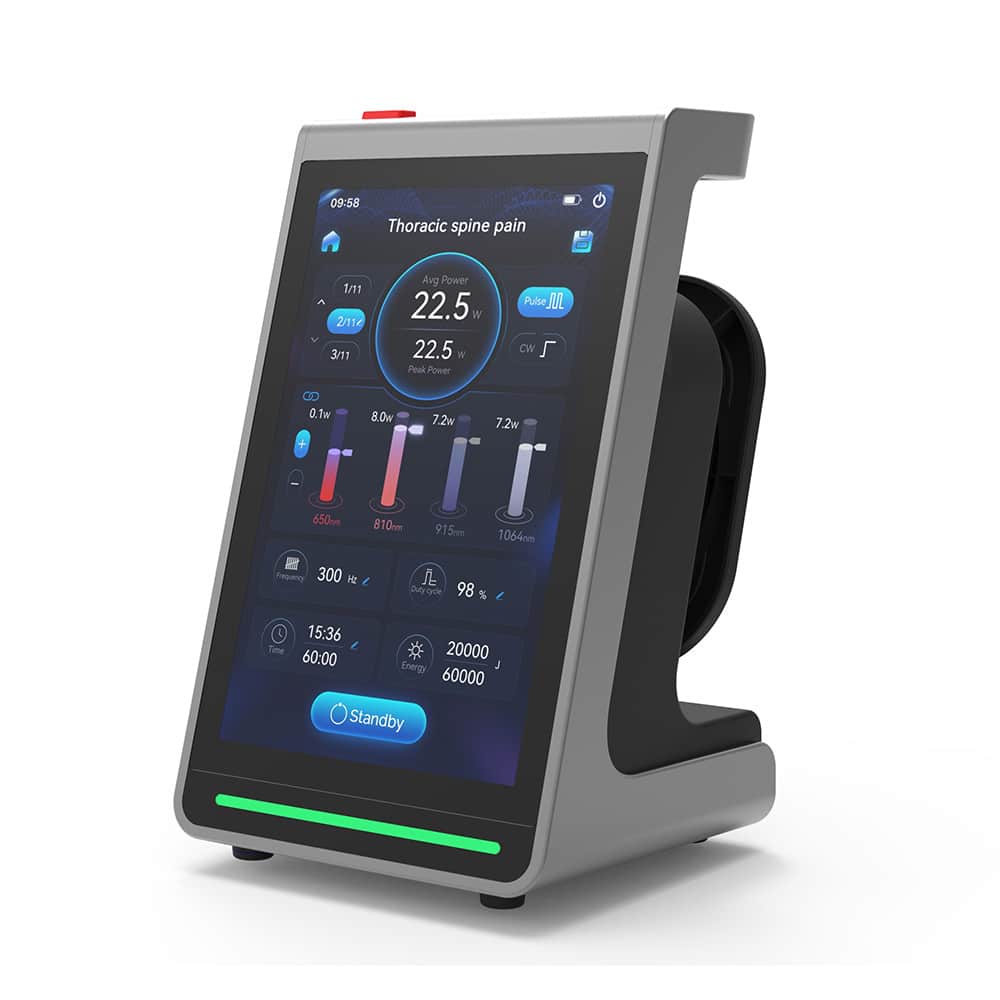
Explore Medray’s Class 4 Lasers
Medray’s Class 4 therapeutic lasers are designed to support circulation, tissue stimulation, and pain relief through a streamlined, repeatable workflow. Discover how laser therapy integrates seamlessly into busy clinics while providing a contact-free option for sensitive presentations.
Shockwave