Why Tattoos Matter in Clinical Laser Therapy
Tattoo pigment functions as an exogenous chromophore, absorbing light more readily than native skin and converting that energy into heat. In practical terms, this increases the likelihood of superficial thermal accumulation, particularly with darker or denser ink.
What is often misunderstood is that this does not mean the deeper tissues beneath a tattoo cannot respond to photobiomodulation. It means that surface behavior and deep tissue goals are no longer perfectly aligned, and the clinician must manage that mismatch intentionally.
From Surface Coverage to Tissue Intent
In musculoskeletal laser therapy, the skin is rarely the therapeutic target. Muscle, tendon, joint capsule, and neural structures lie well below the surface. When tattoos are present, the clinical emphasis shifts away from surface coverage and toward influencing the target tissue.
In practice, this often means treating:
- Adjacent or surrounding tissue rather than directly over dense pigment
- Proximal and distal regions along the same tissue chain
- Larger areas with lower surface concentration rather than focal dwell
How Parameters Are Considered
When clinicians ask about wavelength, power, pulsing, or duty cycle over tattoos, the most important clarification is this: there is no tattoo-specific “safe setting.” Parameters should instead be viewed as tools for managing how energy behaves at the surface.
Shorter visible wavelengths tend to interact more superficially, while near-infrared wavelengths generally favor deeper tissue interaction. Tattoo pigment increases surface absorption regardless of wavelength, so the clinical implication is not to eliminate certain wavelengths, but to be mindful of where and why they are applied.
Average energy delivery over time remains the dominant driver of heating. Features such as pulsed or gated delivery can help distribute energy and manage superficial accumulation, but they do not eliminate risk. The same is true for handpiece movement—it is essential, but not protective on its own.
What Actually Changes at the Handpiece
When tattooed skin lies within a treatment zone, several practical behaviors change, even though the overall treatment goal does not. Clinicians tend to move the handpiece more quickly over pigmented areas, avoid repeated passes in the same location, and broaden treatment patterns rather than concentrating energy. Tattooed regions are treated as higher-variability zones, similar to areas with thin skin or altered sensation.
Patient feedback remains important, but clinicians should recognize its limitations. Tattoo pigment is subdermal, and heat accumulation can occur before visible changes or strong sensations are present. Visual inspection and patient-reported warmth should inform treatment, not define safety thresholds.
Treating Around vs. Treating Through
One of the most underutilized strategies in laser therapy is recognizing that effective treatment does not require direct exposure over every square centimeter of skin. When deeper structures are the goal, treating around tattooed regions often provides clinical benefit while significantly reducing risk.
When direct traversal of tattooed skin is unavoidable due to anatomy or treatment intent, conservative energy distribution, frequent reassessment, and restraint in escalation become critical.
A Responsible Clinical Perspective
The absence of tattoo-specific high-power laser literature means clinicians should avoid false precision. Tattoos introduce uncertainty, not prohibition. The most responsible approach is one that prioritizes tissue intent, manages surface exposure thoughtfully, and respects the limits of current evidence.
High-power laser therapy remains a valuable tool in modern rehabilitation and conservative care, even in heavily tattooed populations. Its safe and effective use depends less on perfect settings and more on how clinicians apply sound principles in variable conditions.
Clinical Application Summary (For Day-to-Day Practice)
- Think tissue, not skin – define the target tissue first
- Bias toward distribution, not concentration – avoid focal dwell over pigment
- Favor influence over coverage – treating around is often sufficient
- Use parameters as controls, not compensations – do not “push through” ink
- Move deliberately – faster, broader passes over tattooed regions
- Monitor actively – patient feedback and skin appearance inform but do not guarantee safety
- Escalate conservatively – uncertainty favors restraint, not intensity
Explore our Class 4 Lasers and Shockwave Therapy Device
Laser
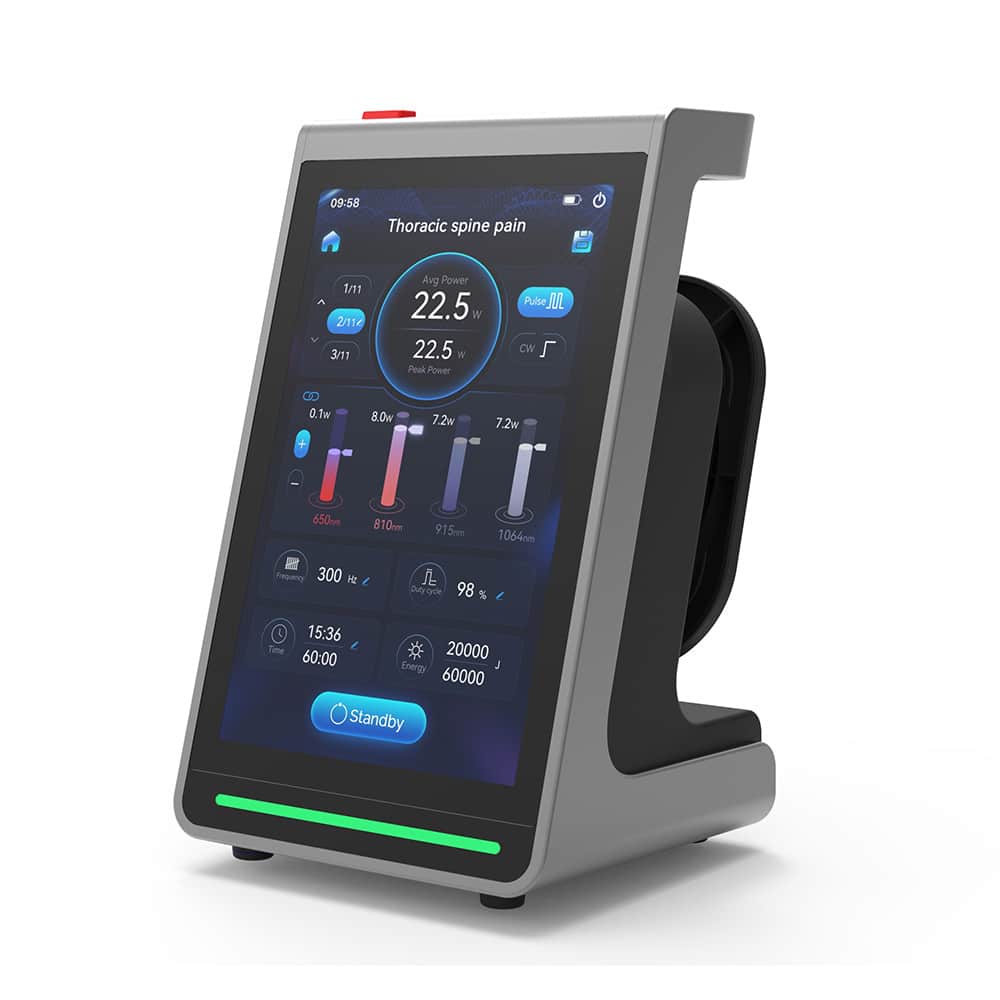
Explore Medray’s Class 4 Lasers
Medray’s Class 4 therapeutic lasers are designed to support circulation, tissue stimulation, and pain relief through a streamlined, repeatable workflow. Discover how laser therapy integrates seamlessly into busy clinics while providing a contact-free option for sensitive presentations.
Shockwave